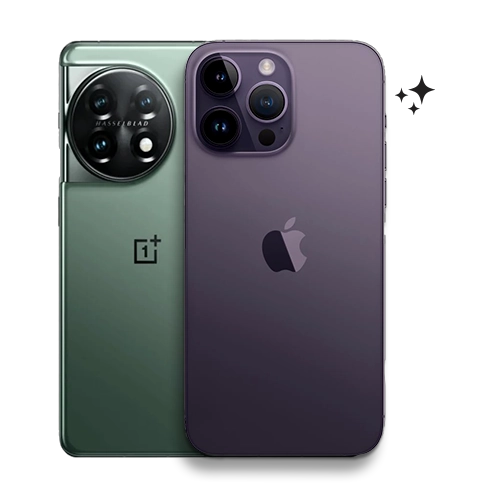


For a very large number of people, the biggest selling point of an iPhone isn’t the ecosystem or its performance—it’s the camera.
We’ve all seen it happen. The person with the newest iPhone in a group setting automatically becomes the designated photographer. Every dinner, birthday party, vacation, or family gathering somehow ends with them taking a bazillion pictures of everyone else. A few hours later (or the next day), the inevitable messages start rolling in:
“Can you send me the photos?”
It’s almost become an unspoken rule at this point. If you have a good iPhone, you’re expected to document the event.
For a device with this much chatter around its camera, there arises a very interesting question: Just how good is the iPhone camera, really?
With every new model, Apple improves the specifications of the camera and the Pro models get the best features – bigger sensors, improved low-light performance, higher-resolution, better stabilization, and increasingly impressive computational photography. You can practically shoot a movie with these phones (or at least that’s what their marketing team leads us to believe).
Marketing tactics or not, nobody can deny that the quality of the iPhone cameras are next level. However, can the iPhone actually replace a dedicated digital camera?
Where the iPhone Shines
The biggest strength of the iPhone isn’t just that it takes great photos—it’s that it makes taking great photos incredibly easy.
You don’t have to think about shutter speed, aperture, balance, or focus. You simply point, tap, and more often than not, the photo looks fantastic. Apple’s image processing handles the complicated work behind the scenes, balancing highlights and shadows, sharpening details, and producing an image that’s ready to share almost immediately.
Then there’s convenience.
Your phone is almost always with you. Whether you’re walking to work or just grabbing coffee, your camera is already in your pocket. There are no extra batteries to charge, lenses to pack, or camera bags to carry around (these things are really heavy, mind you!).
The post-op is also pretty seamless. You can edit your photos seconds after taking them, upload them on social media, send them in the family group chat, or back them up to the cloud without ever touching another device.
And let’s not ignore how capable modern iPhones have become. Portrait mode creates an amazing background blur, Night mode rescues scenes that would have been unusable a few years ago, and video quality has become so good that many creators shoot entire YouTube videos—or even short films—on an iPhone.
For the average person, that’s honestly more camera than they’ll ever need.
Where the iPhone Still Falls Short
As impressive as smartphones have become, there are still areas where physics wins.
Dedicated digital cameras have much larger sensors, which simply collect more light. That translates into cleaner images, and a much better low-light performance. While the iPhone uses software to overcome many of its hardware limitations—and often does so brilliantly—there are situations where software can only go so far.
Lenses are another major advantage. With a mirrorless or DSLR camera, you can swap lenses depending on what you’re shooting. More zoom, more clarity, more focus—basically more everything (image-wise). An iPhone can’t really compete with the flexibility of interchangeable lenses, despite its efforts.
Then there’s creative control.
A camera lets the user intentionally choose their shutter speed, aperture, and countless other technical settings (that I don’t know) to create exactly the image they envision. The critical difference being that the iPhone prioritises making the best-looking image automatically, while a dedicated camera prioritises giving the photographer complete control.
For professionals—whether they’re shooting weddings, sports, wildlife, fashion, or commercial work—that control is indispensable.
So… Can It Replace a Digital Camera?
The answer isn’t as straightforward as yes or no.
If your goal is to create the absolute best image possible in every situation, then no. A dedicated camera still wins. Better sensors, better lenses, and more creative flexibility simply give it a higher ceiling.
But photography isn’t only about image quality. It’s also about being at the right place at the right time.
The best photo you’ll ever take might happen on an ordinary Tuesday during your walk home. A stranger laughing with their child. Light spilling through a rainy window. Scenes from the bustling city life.
Those moments don’t wait for you to go home and grab your camera.That’s where the iPhone has an advantage that no specification sheet can measure.
After all, is the best camera the one that produces breathtaking images but spends most of its life sitting safely on a shelf? Or is it the one that produces really good photos and just happens to be in your pocket every single time inspiration strikes?
For most people, the answer to this question is the answer to our original question—whether the iPhone can replace the digital camera or not.
The iPhone may not have completely replaced dedicated cameras—and for many professionals, it probably never will.
But it has changed what we expect from a camera. It has made great photography accessible, spontaneous, and always within reach (for better or for worse).